How to Find Reputable Tradespeople for a Period Home (and Avoid Costly Mistakes)
If you’re trying to find reputable tradespeople for a renovation - especially in a period or Edwardian home - you’ll come across the same advice again and again.
Get three quotes, check reviews, and make sure everything is written down. All sensible. None of it enough.
Because you can do all of those things - and still end up with the wrong person in your house.
It’s based on experience - the good and the bad.
The Experience That Shows What Not to Do
In a previous property, not long after I left university, my then boyfriend and I decided to carry out some work to make his house feel more like ours.
We were in our 20s - young and keen to get started.
The builder came recommended by someone we assumed we could rely on - someone in a position of significant professional authority. That, more than anything else, gave us confidence.
He walked through the house and told us he could do everything. A small extension to the rear, opening up the ground floor. Structural changes we didn’t fully understand at the time.
All for £8,000 (this was 14 years ago now, but it was still cheap).
He explained the price by saying he had materials left over from another job. At the time, it sounded like we were in luck.
When The Problems Started
Once work began, we moved out.
Very quickly, the house was stripped back to its bare bones - far beyond what we expected. Flooring removed. The staircase taken out entirely.
But we assumed this was part of the process. He was the expert. And I, at least, had only just learned how to work a dishwasher.
Then the problems started.
We were told the floor beams had wood rot. That an expert had confirmed it and more money was needed to continue.
So we found the cash. Then another issue appeared. And another.
By the time it stopped, we had paid an additional £6,000 on top of the original quote.
Violated
At the start, communication was constant - to the point we joked about how often he was in touch.
Then the messages slowed and progress slowed, too. Then the excuses came.
We were told he had injured his arm. It was in a sling which, of course, we took at face value. And then the work stopped.
I can’t remember how the exact conversation went, but we were told the money was gone. I think we must have asked outright why nothing resembling ‘building’ had materialised for £14,000. He said he would pay us back from a future pay-out relating to an injury we couldn’t see (I’m sure you can imagine the part of his body he was referring to…), and return to finish the job once his arm had recovered.
None of it added up and our original reference started ghosting us. By that point, we knew we weren’t getting the money back - and the cost of the damage to the house was already far greater than what we had paid him.
We were in too deep.
And the impact wasn’t just financial. We had effectively lost our home.
The staircase had been removed, so we couldn’t access the upper floors without a ladder. The suspended floor had been taken out, leaving a four-foot drop at the front door. The second floor was precariously being held up by metal supports.
Our belongings upstairs had been rifled through - we later found out radiators and pipework had been taken and sold for scrap.
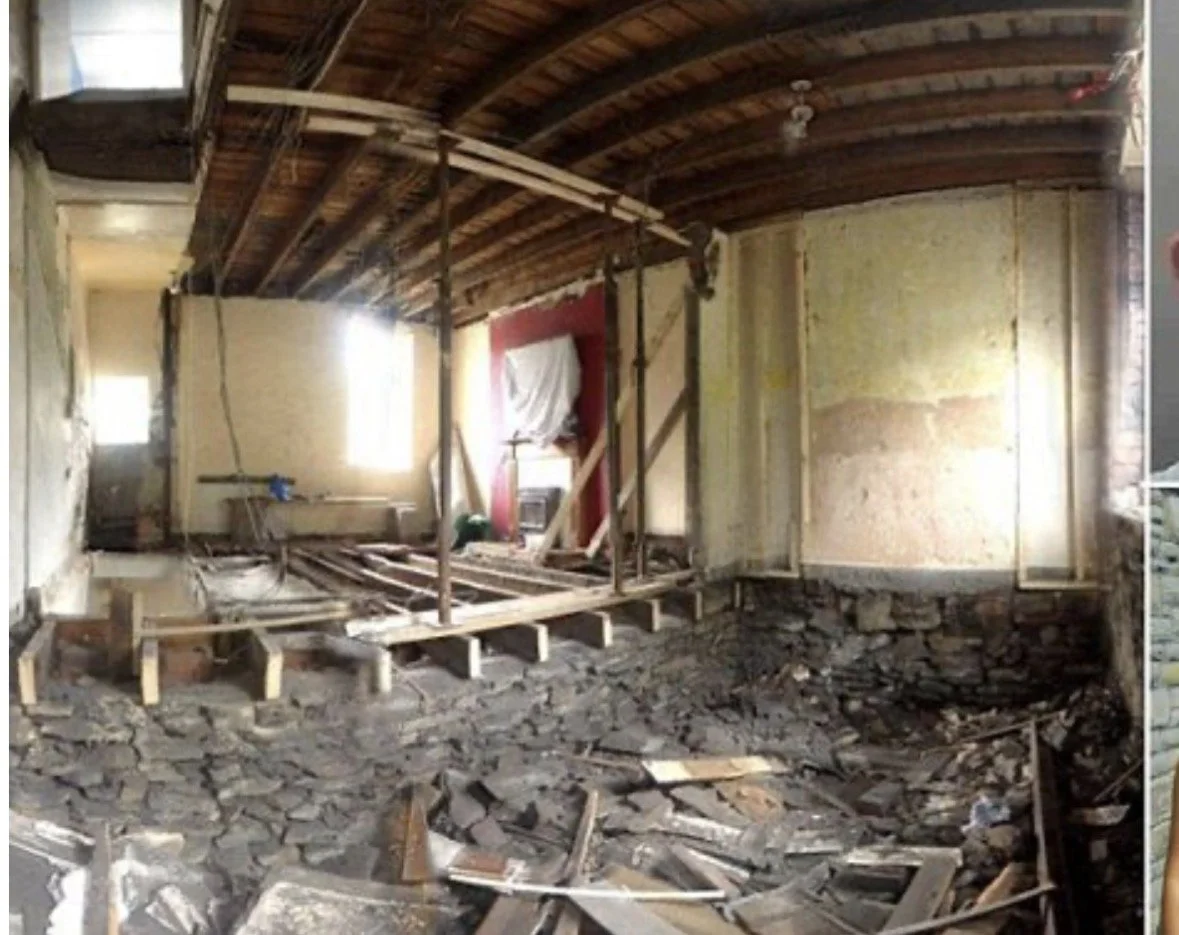
The house as it was left once the builder abandoned the job.
The garden had been used like a skip.
And we were living in a spare room at our parents’ house with no way of returning.
It’s difficult to describe how it felt, but the closest word is probably violated. We had trusted someone, let them into our home. He’d ripped it apart and stolen from us.
It felt like a burglary - only we had let him in, and we had no real means of reparation. Standard home insurance - and even most specialist renovation policies - don’t cover losses caused by rogue tradesmen. The place had been decimated.
And alongside all of that, there was the realisation that the situation had implications beyond the immediate damage - including the validity of the mortgage on a house that was no longer in a habitable state.
The Outcome
We were lucky.
We managed to secure help through a national TV programme, which enabled the house to be put back together. Melinda Messenger and Dominic Littlewood were lovely, ha!
But others weren’t so fortunate.
The builder had carried out similar scams across multiple households, leaving significant damage behind. He was prosecuted and served prison time.
He has since stolen hundreds of thousands of pounds from other people in a similar way. He’s been to prison three times for the same offences and is now banned from carrying out building and maintenance work.
Why This Matters
This experience is extreme - but it isn’t irrelevant.
There are lower key versions of this happening every day.
And the protections available to homeowners are far more limited than most people assume.
I’ve also experienced the other side - renovating an Edwardian home - where the people involved have been skilled, professional, and trusted.
I’m hopeful that people can learn from both experiences so that no one has to go through the financial and mental anguish that comes with someone destroying one of the most precious things to you - your home.
The Most Important Principle: Who You Take Recommendations From
My experience made it evident that not all recommendations carry the same weight - even when the person making the recommendation is in a position of significant trust.
If you knew who made the recommendation, you would never believe that they would have sent a criminal to our home. You’d understand why we trusted them.
If you can, prioritise recommendations from people within the trade - or from professionals like architects - who understand the work and have a reputation of their own to protect.
And just as importantly, make sure the person making the recommendation is someone you know and trust.
A recommendation is only as strong as the person giving it.
Platforms like Checkatrade can be used for a purpose.
For me, they’re fine for cosmetic or finishing trades - decorating, tiling, smaller contained jobs.
Anything structural, technical, or higher value I wouldn’t rely on a directory alone. I’d want a strong, known recommendation from someone within the trades.
Red Flags Not to Ignore
Looking back, there were signs.
But if you’ve never done building work before, you’d likely miss them. And even if you have, some of them can feel like you’ve just found someone particularly conscientious or keen.
Now, they’re things I’d pause on - and encourage you to as well.
Overcommunication
Constant messaging can feel reassuring at first. In reality, it can be a sign of pushiness, a need to secure the job quickly, or a way of keeping you on side while progress stalls.
Even for our Edwardian project I had one person become really pushy in the beginning. My spidey-senses peaked and I respectfully declined their services.
“I’ve got materials left over from another job”
It sounds like a benefit. It usually isn’t. Pricing should be clear and specific to your project.
Large upfront payments
Large upfront payments should be questioned too. They aren’t uncommon for materials, but ask for receipts.
Another trade for our Edwardian project asked for a deposit - no real explanation. The others quoting didn’t. He didn’t make the cut.
Reputable builders will usually have accounts with builder’s merchants and can purchase materials through them on credit until an agreed payment date when they’ve completed an amount of the work. If they can’t, that’s worth questioning.
Offering to do everything
Some people can cover multiple areas, but it’s unlikely one person is equally qualified as a builder, roofer, electrician, and Gas Safe engineer.
If a one-man-band (and yes, it’s usually a man) saying they will construct your entire extension single-handedly without any external help, question it.
Lessons learned
Whether you’re renovating an Edwardian home or a newer property, there are a few simple things I’d do every time:
Start with trusted recommendations - ideally from within the trade or through an architect
Ask to see examples of previous work - and visit them if you can
Take your time with anyone whose work will affect the structure or systems of your home
Google their name - have they appeared anywhere they shouldn’t? Not always a guarantee as my earlier builder changed his
Check for CCJs
Because once someone is in, work has started, and money has been spent, your options narrow quickly.
Final Thought
I’ve seen what happens when you get this wrong.
And I’ve seen what it looks like when you get it right.
If this helps even one person avoid the financial and emotional impact of getting this wrong, it will have been worth sharing.
